AI Overviews
How to Rank in Google AI Overviews: What 1,940 India Searches Show
How Google picks the pages it cites in AI Overviews, with data from 1,940 Google India searches: citation rates by ranking position, the sources cited, and 8 steps with the evidence for each.
On this page+
To rank in Google AI Overviews, a page needs to sit in Google’s index with snippets allowed, rank on the first page for the search or for one of the related searches Google runs behind it, and answer the question in a passage short enough to quote. Ranking position matters most. In 1,940 Google India searches we captured between 14 October and 14 November 2026, the AI Overview cited the first organic result 51.5% of the time and the ninth result 17.7% of the time.
This guide covers what our data shows, what Google says about how AI Overviews pick sources, eight steps to get cited with the evidence behind each, and how to measure the result.
70% of searches showed an AI Overview
1,356 of 1,940 Google India searches, mostly product, supplier and gifting keywords. Travel keywords showed one on 29%.
Position 1 is cited half the time
The AI Overview cited the first organic result in 51.5% of cases, falling to 17.7% at position 9.
44% of cited pages were not on page one
Of 5,075 cited pages, 2,216 did not appear in the first-page results for that search.
Product searches pull in Google Shopping
558 AI Overviews (41%) linked Google Shopping product cards next to web pages.
What it means to rank in an AI Overview
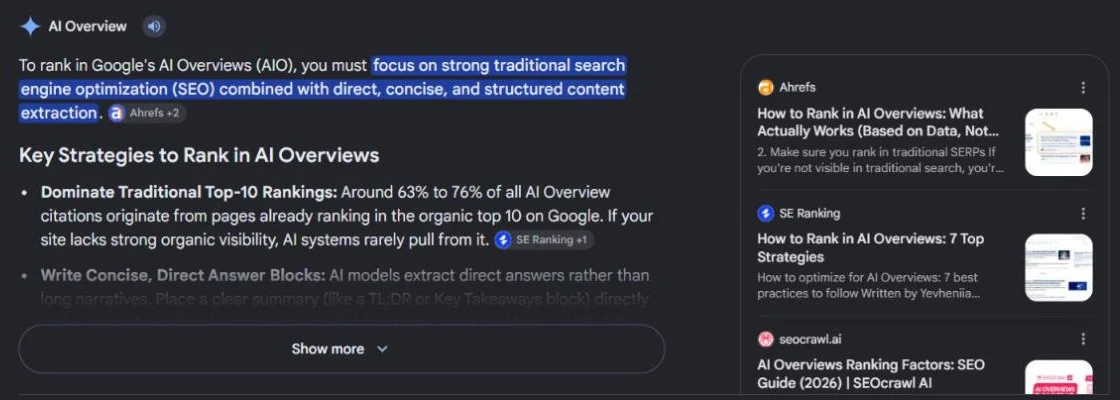
An AI Overview is the AI-generated summary Google shows above the organic results for some searches, written by Google’s AI model from pages in its index. Your page “ranks” in it when Google cites the page as a source: a link card in the side panel, or a small link icon after a sentence.
Three facts shape the work:
- AI Overviews appear only on some searches. Google says they show “when our systems determine that it is additive to classic Search, and as such, often don’t trigger.”
- The sources change. The same search can show a different set of links on a different day. Measure citations as the share of checks over time where your page appears.
- Google uses the same index as normal search. Google’s rule for supporting links is short: the page has to be in the index and able to show a snippet. Nothing beyond the normal Search requirements applies.

What 1,940 Google India searches show
We capture Google results for every keyword we research for clients and for our own sites. Each capture records the AI Overview, the pages it cites and the organic results on the same page. For this guide we pooled every capture from 14 October to 14 November 2026: 1,940 unique keywords, Google India, English results. We removed brand searches and searches with site: or quote operators.
Limits of the data: the keywords come from our client work, so industrial B2B terms make up 1,186 of the 1,940 and some sectors have small samples. 1,386 source links were hidden behind Google redirect tokens and could not be read, so the citation figures use the 5,075 cited pages we could identify. Treat the numbers as a large sample of real Indian commercial searches. They are not a random sample of all Google searches.
Which searches trigger an AI Overview

1,356 of the 1,940 searches (69.9%) showed an AI Overview. Ahrefs found AI Overviews on 21% of keywords across 146 million results pages, with question searches far more likely to trigger one. Our rate is much higher because our keywords are product and supplier terms, which in India now often get an AI Overview listing products, prices and brands.
By the type of search, the rate stayed between 61% and 86% in every group:
| Type of search | Searches | With an AI Overview |
|---|---|---|
| Price or cost (“bp machine price”) | 14 | 85.7% |
| Buy or supplier (“2k epoxy primer manufacturers”) | 61 | 75.4% |
| Question (how, what, why) | 31 | 74.2% |
| Comparison (X vs Y) | 20 | 70.0% |
| Product or topic term (“digital thermometer”) | 1,791 | 69.6% |
| Best or top list | 23 | 60.9% |
The groups other than product terms are small, so read them as direction. Length made little difference: 72.7% of one- and two-word searches showed an AI Overview, and 75.3% of searches with six or more words.
Ranking position decides most citations
For every AI Overview with readable sources, we checked whether each organic result on the same page was also cited.

The chance of being cited drops at every step down the page, from 51.5% at position 1 to 17.7% at position 9. 81.4% of these AI Overviews cited at least one first-page result. Moving a page from position 6 to position 2 is still the most reliable way to get into the AI Overview for that search.
But 44% of cited pages were not on page one

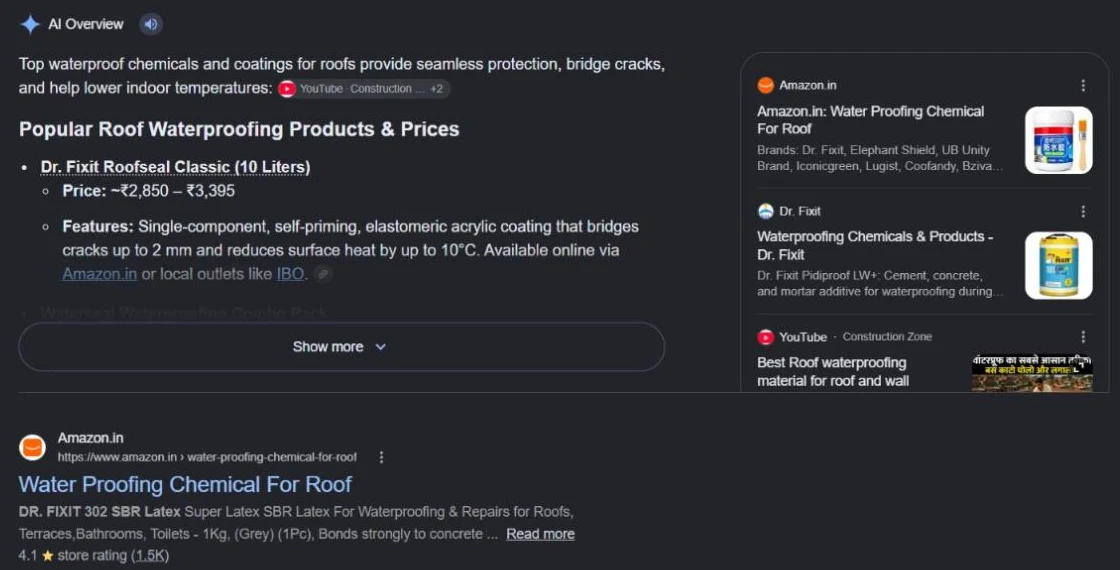
2,216 of the 5,075 cited pages did not appear in the first-page organic results for the search that showed the AI Overview. Google’s documentation explains the gap. Behind one search, it issues several related searches on subtopics (it calls this query fan-out) and can cite pages found through any of them. For example, a page that ranks only for a cost or method question about roof waterproofing can still be cited on the AI Overview for “waterproofing chemical for roof”.
Published studies put the overlap anywhere from 38% to 76%, and ours sits in the middle:

Ahrefs warns against reading its 2025 and 2026 figures as a trend, since it changed how it detects citations between them. It also points to fan-out searches and the January 2026 switch to Gemini 3 as reasons for the lower figure. BrightEdge found the overlap varies by sector, with healthcare and education above 75% and ecommerce barely changing.
What kind of pages get cited

Three in four cited pages came from brand websites, publishers and blogs, spread over 1,705 domains. The rest came from a small set of large platforms. YouTube was the most cited single domain (398 pages), followed by amazon.in (156) and IndiaMART’s directory (121). For Indian product and supplier searches, your listing on a marketplace or directory can be the page Google cites, even when your own site is not.
On top of web pages, 558 of the 1,356 AI Overviews linked Google Shopping product cards. On those searches, your product data in Merchant Center feeds the AI Overview as well as your web page.
One client example
WeHatke, a personalised gifts store on Shopify and one of our ecommerce SEO clients (case study), ranked on the first page for 12 searches in the sample that showed an AI Overview with readable sources. The AI Overview cited WeHatke on 5 of them. All 5 were searches where WeHatke ranked at position 2 or 3. On the other 7 it ranked between 2 and 10 and was not cited. A first-page ranking put the store in the running, and the AI Overview still picked other pages more often than not.
How Google chooses AI Overview sources
Google’s documentation and the published studies point to the same process:
- Google decides whether the search needs an AI Overview. Many do not.
- It runs the main search plus related searches across subtopics (query fan-out).
- It reads pages that rank in those searches from the normal Google index. Pages that are not indexed or not allowed to show a snippet are out.
- It writes the answer with Gemini and links the pages whose passages support each part of it, plus product cards from Google Shopping when the search is about products.
This is why the steps below start with normal search eligibility and ranking, then move to coverage of related questions and presence on other sites.
How to rank in Google AI Overviews: 8 steps
| Step | Evidence |
|---|---|
| 1. Make the page eligible | Google: only indexed pages that can show a snippet qualify |
| 2. Rank on page one for the main search | Our data: 51.5% cited at position 1, 17.7% at position 9 |
| 3. Answer the follow-up searches Google runs | Our data: 43.7% of cited pages were not on page one; Ahrefs: pages ranking for fan-out searches 161% more likely to be cited |
| 4. Answer in a short passage under a matching heading | Ahrefs: word count shows near-zero correlation with citations |
| 5. Keep product and business data current | Our data: 41% of AI Overviews linked Google Shopping cards; Google lists Merchant Center and Business Profile |
| 6. Be present on the platforms Google cites | Our data: YouTube, Amazon and IndiaMART were the top cited domains |
| 7. Earn brand mentions on other sites | Ahrefs: branded web mentions correlated 0.664 with AI Overview visibility, backlinks 0.218 |
| 8. Support the text with images, video and accurate structured data | Google’s best-practice list for AI features |
1. Make the page eligible
Check these in Google Search Console’s URL Inspection tool for each page you want cited:
- The page is indexed (“URL is on Google”).
- No
noindex,nosnippetor very lowmax-snippetvalue in the HTML or the HTTP headers. - Googlebot is allowed in robots.txt, and your CDN or firewall does not block it. Google’s own list names CDN and hosting blocks as a check.
- The main content is in the HTML as text, so Google can quote it.
A page that fails any of these cannot be cited, so this is the first item in every technical SEO review we run.
2. Rank on page one for the main search
The citation rate falls at every position, so traditional SEO work moves AI Overview visibility directly: a title and heading that match the search, content that answers it better than the pages above you, internal links from related pages, and links and mentions from other sites. Ahrefs found the median position of the most cited page in AI Overviews was 2.
3. Answer the follow-up searches Google runs
To find the related searches Google may run, look at the “People also ask” box, the related searches at the bottom of the page and the subheadings of the AI Overview itself. Then make sure your page, or a page you link to from it, answers each one. Ahrefs reports research by Joshua Hardwick with Surfer: pages that rank for fan-out searches were 161% more likely to be cited than pages ranking only for the main term, with a 0.77 correlation.
This is how topical authority shows up in AI Overviews. Build these as a cluster: one main page for the search, and supporting pages for the sub-questions that need their own depth, linked both ways. A pricing question or a comparison usually deserves its own page; a definition usually does not.
4. Answer in a short passage under a matching heading
Google quotes passages, so give it one to quote:
- Write the heading in the words people search, for example “How much does roof waterproofing cost in India?”
- Answer it in the first one or two sentences under the heading, with the number, the name or the yes or no.
- Add the detail, the conditions and the source after that.
- Use a table for prices, specifications and comparisons, and a numbered list for steps.
Length does not earn citations by itself. Ahrefs found a Spearman correlation of about 0.04 between word count and AI citations, and reports Dan Petrovic’s finding (7,000+ queries) that the text Google uses from a page levels off at around 540 words. Cut sections that drift from the question.
5. Keep product and business data current
On 41% of the AI Overviews in our sample, Google linked Google Shopping product cards. For a store, that makes the Merchant Center feed part of AI Overview optimisation: accurate titles, prices, availability and images. Google’s best-practice list for AI features also asks you to keep Merchant Center and Business Profile information up to date. For local services, the Business Profile plays the same role.
6. Be present on the platforms Google cites
Look at the source cards on the AI Overviews for your ten most important searches and list the domains. In our Indian sample, YouTube, Amazon, IndiaMART, Facebook, Instagram and Reddit came up again and again. For each one that cites your competitors:
- YouTube: publish short videos that answer the same questions as your key pages, with the question in the title.
- Marketplaces and directories: keep your Amazon, Flipkart, IndiaMART or Justdial listings complete, with the same product names, specifications and prices as your site.
- Reddit and Quora: answer questions where your expertise is relevant, under your own name, without links in every answer.
7. Earn brand mentions on other sites
Ahrefs studied 75,000 brands and found that branded web mentions correlated with AI Overview brand visibility at 0.664, three times the correlation for backlink count (0.218). In another Ahrefs study of brand visibility, YouTube mentions had a correlation of about 0.737. These are correlations, but they point the same way as our source data: Google’s answer draws on what other sites say about you as well as on your own pages. Industry publications, comparison articles, supplier lists and client case studies all count.
8. Support the text with images, video and accurate structured data
Google’s best practices for AI features include high-quality images and video next to the text, and structured data that matches the visible text on the page. Use them for those reasons. Do not expect schema alone to earn a citation (see below).
- 1Key pages are indexed, with no noindex, nosnippet or low max-snippet.
- 2Googlebot is allowed in robots.txt and by the CDN or firewall.
- 3Each key page ranks on page one, or there is a plan to get it there.
- 4The related questions from People also ask and the AI Overview are answered on the page or a linked page.
- 5Every key heading is a question in the searcher's words, answered in the first sentence below it.
- 6Merchant Center and Business Profile data match the website.
- 7Your brand is listed on the marketplaces, directories and video platforms the AI Overview cites for your searches.
- 8Images, video and structured data match the visible text.
What does not help
- New files for AI crawlers, such as llms.txt. Google’s AI features page says sites need no extra files written for AI systems, no special markup and no particular schema.org type to appear.
- Adding schema in the hope of a citation. In Ahrefs’ test, 1,885 pages already cited in AI Overviews added JSON-LD and were compared with 4,000 similar pages that did not. The pages with new schema lost 4.6% of their AI Overview citations.
- Making pages longer. Word count showed almost no correlation with citations in the Ahrefs data. A focused answer is easier to quote.
- Blocking or allowing Google-Extended. Google says Google-Extended “does not impact a site’s inclusion in Google Search”. It controls training and grounding in some of Google’s other AI systems.
How to track AI Overview visibility
Google Search Console includes AI Overview and AI Mode appearances in the Performance report under the Web search type, mixed with normal results. There is no filter to separate them. To measure AI Overviews you need a separate method:
- Pick 20 to 50 searches that matter for revenue.
- Check them on a schedule, weekly or monthly, from the country you sell in. Record whether an AI Overview appears, which domains it cites and whether yours is one of them.
- Report the share of checks where you were cited, per search group, and compare it with your organic positions.
- Watch clicks and time on site in GA4 for the pages that get cited. Google says clicks from results pages with AI Overviews tend to be higher quality, with more time spent on the site.
Expect fewer user clicks and less organic traffic per impression on these searches. Pew Research found people clicked a traditional result on 8% of visits to results pages showing an AI summary, against 15% when none appeared, and followed one of the summary’s own source links on just 1% of visits. Seer Interactive measured organic CTR of 2.4% on searches with an AI Overview in February 2026, against 3.8% on searches without. Being cited keeps your brand in front of the buyer when fewer people scroll.
AI Overviews vs AI Mode
| AI Overviews | AI Mode | |
|---|---|---|
| Where it shows | Above the results on the normal search page, on some searches | A separate tab for longer, conversational searches |
| When it shows | Only when Google judges it adds something | Whenever the user opens it |
| How it finds sources | Query fan-out across related searches | Query fan-out across related searches |
| Eligibility | Page in the index, snippet allowed | Same rule as AI Overviews |
| Models | Can differ between the two, per Google, so the cited links differ |
In India, “google ai mode” is searched about 368,000 times a month and “ai overview” about 18,100 times (Google Ads Keyword Planner, 12-month average, November 2026). The groundwork for both is the same. Our guide to ranking in ChatGPT covers the assistants that do not use Google’s index.
How to stop content appearing in AI Overviews
Google treats AI Overviews as part of Search, so the controls are the normal snippet controls:
nosnippetkeeps the page’s text out of snippets and AI features.data-nosnippeton an element keeps that part of the page out.max-snippet:[number]limits how much text Google can show.noindexremoves the page from Search altogether.
Each of these also limits how the page appears in normal results, so use them only on content you are willing to show less of.
Sources and studies used here
| Source | What it measured | Key figure |
|---|---|---|
| FansGain (this guide) | 1,940 Google India searches, Oct to Nov 2026 | 51.5% citation rate at position 1; 43.7% of cited pages not on page one |
| Google Search Central | Official guidance on AI features | Normal Search rules only: index plus snippet eligibility |
| Ahrefs, how to rank in AI Overviews | 146 million results pages; 1.9 million citations | AI Overviews on 21% of keywords; fan-out rankers 161% more likely to be cited |
| Ahrefs, rankings vs AI citations | 1.9 million citations, July 2025 | 76.1% of cited pages in the top 10 |
| Search Engine Journal on Ahrefs’ 2026 data | 863,000 keywords, March 2026 | 38% of cited pages in the top 10 |
| BrightEdge | 16 months of AI Overview tracking | 54.5% of citations also rank organically |
| Ahrefs, brand visibility factors | 75,000 brands | Branded mentions 0.664, backlinks 0.218 |
| Ahrefs, schema test | 1,885 pages that added schema | AI Overview citations down 4.6% |
| Pew Research Center | Browsing behaviour on Google results pages, July 2025 | 8% click a result with an AI summary vs 15% without |
| Seer Interactive | 53 brands, 5.47 million queries | Organic CTR 2.4% with an AI Overview vs 3.8% without |
Ahrefs, BrightEdge and Seer sell SEO or AI visibility tools or services, as we do, and most of their figures show correlation. Read them as pointers, and confirm any of them against your own keyword list before acting.
Where to start
This week, search your ten most important keywords on Google from India. For each one, note whether an AI Overview appears, which domains it cites, and where your page ranks. Searches where you rank in the top 3 and are not cited need a better passage (step 4). Searches where you rank below position 5 need ranking work first (step 2). Searches where marketplaces and YouTube fill the citations need presence on those platforms (step 6).
Our AI SEO team runs the same check across every keyword you track. You get AI Overview presence per search, how often each competitor is cited, and a ranked list of fixes.
Ranking in Google AI Overviews: frequently asked questions
How do I get my website into Google AI Overviews?+
Get the page into Google's index with snippets allowed, rank it on the first page for the search and its related sub-searches, and answer the question in a short passage right under a heading that matches it. In 1,940 Google India searches we captured, the first organic result was cited by the AI Overview on the same page 51.5% of the time. Google says there are no extra requirements or special markup.
Do I need to rank in the top 10 to appear in an AI Overview?+
It helps a lot but is not required. In our sample, 56.3% of the pages cited in AI Overviews also ranked on the first page for that search, and 43.7% did not. Google builds AI Overviews from several related searches, so a page that ranks for one of those sub-searches can be cited without ranking for the main term.
Will adding schema get my page into AI Overviews?+
Google's documentation lists no special schema.org type for AI Overviews. In an Ahrefs before-and-after test on 1,885 pages, AI Overview citations dropped 4.6% after the pages added JSON-LD. Keep structured data accurate for rich results and expect no citation gain from it.
How many sources does an AI Overview cite?+
In our sample the median AI Overview cited 4 distinct web pages, not counting Google Shopping product cards. Pew Research found 88% of AI summaries cited three or more sources.
Can I see AI Overview traffic in Google Search Console?+
Only inside the overall numbers. Google counts AI Overview and AI Mode appearances in the Performance report under the Web search type, with no separate filter. To see which searches show your page in an AI Overview you need manual checks or a SERP tracking tool.
Do AI Overviews reduce clicks?+
Usually, yes. Pew Research found people clicked a traditional result on 8% of visits to a results page showing an AI summary, against 15% when none appeared. Seer Interactive measured organic CTR of 2.4% on searches with an AI Overview in February 2026 versus 3.8% without. Google says clicks from AI Overview pages tend to be higher quality, with more time spent on the site.
How do I stop my content appearing in AI Overviews?+
Use nosnippet, data-nosnippet, max-snippet or noindex. Each of these also limits how the page shows in normal search results. Blocking Google-Extended does not remove a page from AI Overviews, because it only controls use in some of Google's other AI systems.
Is ranking in AI Overviews the same as ranking in AI Mode?+
No. Google notes that the two features can run on different models, so their answers and source links differ. Both split a search into related searches and both draw on indexed pages that can show a snippet, so the same groundwork serves both.
Related: AI SEO services, technical SEO services, ecommerce SEO services, how to rank in ChatGPT.
Written by
Sunil Pratap Singh
SEO & GEO Consultant · Founder, FansGain
Independent SEO and GEO / AI-visibility consultant with 15+ years in digital marketing, and creator of the Search Signal Framework. He helps brands get ranked in Google and cited inside AI answers.
Work with us
Want your brand found in Google and cited in AI answers?
We run SEO, AI SEO and paid media as one system. Start with a free visibility audit.
Get a Free Audit